Le Forum Catholique

http://www.leforumcatholique.org/message.php?num=814100
images/icones/union-jack.png  ( 814100 )Voici le nouveau général des Jésuites par Jean Kinzler (2016-10-19 14:40:31) 

A brief note on Father Arturo Sosa

Antonio Francés (nom-de-plume)

Dear friend,

I have known Father Arturo Sosa Abascal for a long time. Unfortunately, what I have seen in him is not in line with the teaching of Christ.


First of all, he has made of Marxism the lenses through which he sees everything including the Catholic Magisterium (which he calls merely“Christian Faith”). He, along with many other Jesuits in Venezuela, has worked for decades in order to build “comunidades cristianas de base” (“Basic ecclesial communities”) committed to building Socialist societies in Latin America and Venezuela. Communities which live Marxism and Christianity not as the philosophers, thinkers, theologians of Europe. (Here he seems to forget China, by the way), but in their own way.

Once the Jesuits had completed this work, then Father Sosa acted so that theology had to be reconstructed with this commitment of the "grassroots" as the guiding principle, because, as Marx taught, praxis is the birth place of theory, and theory is built in order to guide practice. He claims that the Gospel is the norm of the Christian, but that it is in such a condition where it cannot inspire the basic commitments and tools of understanding, because these are historically conditioned. So, the experience of "exploitation" decides the fundamental orientation of the grassroots, and from this viewpoint they have to approach the “gospel.”

The Christian faith means nothing else than to be able to approach “the other”, that is to say, "the poor", the "oppressed", which becomes the “view point.” Thus, faith is mediated by other groups of men. The man of faith has a scientific approach to reality and he has to choose what scientific approach he adopts. Faith will be mediated by this option. In this moment of history, therefore, the right mediation is that of Marxism, because Marxism is the liberating scientific approach, because it is the best way to unmask the powerful and to guide the struggle of the poor.

After this, he followed the conventional path of the Marxist Liberation theology: he rejects the transcendence of Christ’s Kingdom, proposes a political salvation, adopts materialism and even atheism, and assumes that Christianity must liberate the people politically as Moses did with Israel. (See this article: http://gumilla.org/biblioteca/bases/biblo/texto/SIC1978402_64-67.pdf).

Father Sosa has lived his life in conformity with these “theoretical” foundations. At the Catholic University Andrés Bello (UCAB), the students could see never wearing signs of his priesthood. He gave talks side by side with González Fausz in order to uproot God’s worship from the students (spending money in the cult of God would be wrong: the best “Christian” tradition since John Chrysostom just took care of the poor). His work as editor of the journal SIC and as Director of the Gumilla Center served well to destroy the Faith of many a young person, including a very good friend of mine. (The reader can see his papers here: http://revistasic.gumilla.org/biblioteca-sic/arturo-sosa-s-j/).

In 1989 there was a big popular uprising in Caracas due to the work of a liberal Minister of Economy. It was known afterwards that Fidel Castro was behind it. The “grassroots communities” of the Jesuits worked very actively and the radio in charge of which were mostly the Jesuits, “Fe y alegría”, played an active subversive role. Thus, they became co-responsible in the death of 2,000 people.

Later, the Jesuits worked actively in the coming of the Chavista revolution. There were Jesuits who opposed Chávez, that is true. Some very strongly. Now, in April 2002, when Chávez was out of office for a couple of days, people heard Father Sosa proclaim that the grassroots “Christian” communities would defend the Revolution to death, that the “right-wing” [?] would see the strength of the Revolution...

This man who has worked very hard all his life to re-interpret Christianity from a Marxist viewpoint, who has done not only “theoretical” work, but direct Revolutionary work, is the one that the Jesuits now have elected as their General. Perhaps the growing revolutionary moment in Colombia, checked by the population itself in the referendum that voted down Marxist demands that would have been inserted in their own Constitution -- and for which their president won, unsurprisingly, the Nobel Peace Prize), demands that. But one still remains mystified: what is it that the revolutionary are after, still? In Venezuela they have systematically destroyed the productive infrastructure, agriculture, industry, public administration, the courts, hospitals, schools, even the energy industry that supports the country; they have killed thousands of people, they have the country at the edge of disastrous famine never before seen in such scale in the Americas. What is it that they are after? Probably the only explanation is the utter destruction of God’s world in order to build “a New World” in history. May God protect us from the revolutionary underworld. May God convert the hearts and open the eyes of his people. And, above all, may Christ protect His Church.
RC

images/icones/photo.gif  ( 814103 )Portrait et photo de la messe précédant l'élection par Gaspard (2016-10-19 15:25:09) 
[en réponse à 814100]

Portrait du nouveau général des Jésuites sur le site officiel de la Compagnie de Jésus jesuits.org :

Jesuits celebrated the Mass of the Holy Spirit at Santo Spirito Church before electing a new Superior General Oct. 14 :
images/icones/neutre.gif  ( 814185 )Portera-t-il un jour la soutane par AVV-VVK (2016-10-20 21:44:06) 
[en réponse à 814103]

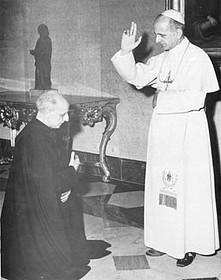
comme jadis (parfois) le T.R.P. Kolvenbach et (parfois) même le prédécesseur plénier de lui, Arrupe (+)?
images/icones/1f.gif  ( 814186 )Pour vous servir par Lycobates (2016-10-20 21:58:13) 
[en réponse à 814185]

soutane et manteo.
Très "classe".


Un Basque pour fonder la Compagnie, un autre Basque pour la détruire.

Le cercle est bouclé.
Tout ce qui a suivi et qui suit n'est qu'une bataille d'arrière-garde.
images/icones/neutre.gif  ( 814189 )Pourtant une image consolante. par AVV-VVK (2016-10-20 23:45:26) 
[en réponse à 814186]

Le T.R.P. A. Nicolàs fut le premier préposé général à se montrer en tenue de clergyman chez le pape.
images/icones/1n.gif  ( 814107 )La seule citation référencée date de... 1978 par Gaspard (2016-10-19 15:43:05) 
[en réponse à 814100]

C'est un lien avec un article du nouveau général des Jésuites intitulé "la médiation marxiste de la foi chrétienne" écrit en 1978, il y a 38 ans !

Il est bien possible que les conceptions du nouveau général des Jésuites soit désastreuses, mais cet article procède par affirmations sans démonstration.
images/icones/carnet.gif  ( 814112 )Un général social à la tête des Jésuites par Jean Kinzler (2016-10-19 16:46:32) 
[en réponse à 814107]

Le P. Arturo Sosa, un général social à la tête des jésuites
Nicolas Senèze, envoyé spécial permanent à Rome, le 16/10/2016 à


Les jésuites ont élu vendredi 14 octobre comme nouveau préposé général le P. Arturo Sosa, un Vénézuélien de 68 ans, premier non-Européen à succéder à saint Ignace de Loyola

Après un Néerlandais au Liban et un Espagnol missionnaire au Japon, c’est donc bien hors d’Europe que la Société de Jésus est allée chercher le successeur de saint Ignace, en la personne du Vénézuélien Arturo Sosa Abascal, 68 ans, élu vendredi 31e préposé général. « Il a toutes les qualités humaines et spirituelles pour répondre aux défis de la Compagnie dans les années qui viennent », se réjouit le P. Federico Lombardi, un des assistants de l’ancien général.


Cet homme au sourire amical, barré d’une large moustache blanche lui donnant un air de solide et sage grand-père, a derrière lui une solide expérience universitaire en sciences politiques qu’il a enseignées à l’Université Andrés-Bello de Caracas et à l’Université centrale du Venezuela, avant d’être recteur de l’Université catholique du Tachira, à la frontière avec la Colombie (ouest) où il a aussi travaillé à la réconciliation dans une zone de tension entre les deux pays.

Engagement à gauche

Car ce spécialiste reconnu des questions sociales et politiques n’en est jamais resté à la théorie. Coordinateur de l’action sociale des jésuites vénézuéliens puis directeur du Centre Gumilla, le centre d’investigation sociale des jésuites (l’équivalent vénézuélien du Céras français), ce fils d’un ministre social-chrétien des finances s’est même fortement engagé politiquement à gauche.

Selon la presse vénézuélienne, très critique contre les dérives de la démocratie représentative de son pays dans les années 1990, il a défendu en 1992 les deux coups d’État d’Hugo Chavez, dont il s’éloignera cependant à la décennie suivante à cause des atteintes aux droits de l’homme.

« Il est très engagé socialement, mais aussi profondément spirituel. Un homme de gouvernement, également, qui connait bien la Compagnie », résume le P. Antonio Spadaro, directeur de la revue jésuite italienne La Civiltà cattolica, et qui fut le voisin du nouveau général pendant cette congrégation générale.

Répondre aux enjeux à l’échelle du monde

Il l’a aussi souvent croisé à Rome où, depuis 2014, le P. Sosa avait la charge d’assister le P. Adolfo Nicolas, son prédécesseur, pour les maisons et les œuvres interprovinciales. C’est-à-dire toutes les institutions dépendant directement du préposé général, de la curie généralice elle-même à l’Université grégorienne, en passant par l’Observatoire du Vatican et les collèges internationaux.

« C’est un homme d’une grande humanité et d’une grande ouverture, qui a laissé un excellent souvenir aux jésuites de son pays quand il était provincial de 1996 à 2004 », ajoute le P. Gabriel Ignacio Rodriguez, assistant général pour l’Amérique du Sud. Pour ce Colombien, la nationalité du nouveau général n’a que peu joué dans l’élection. « C’est un homme d’expérience, qui a déjà participé à quatre congrégations générales, explique-t-il. Nous sommes allés chercher un homme de vision, capable de planifier une action pastorale au niveau mondial. »

À ses yeux, c’est en effet à la dimension du monde que se jouent les défis de l’ordre dans les prochaines années, que ce soit la question des migrations, de la mondialisation du dialogue interculturel, de l’inculturation ou de la justice sociale. Autant de « frontières », auxquelles le pape François, lui-même ancien jésuite venu d’Amérique latine, ne cesse justement d’appeler ses anciens confrères à se porter.

« Dépasser la pauvreté et l’exclusion »

En 2008, lors de la précédente congrégation générale, le P. Sosa était d’ailleurs intervenu sur ces frontières qu’ils voyaient comme « un signe difficile » : à la fois « une limite », mais aussi « la possibilité d’aller au-delà, de se déplacer vers des zones moins connues ».

Il invitait alors la Compagnie à aller vers « les frontières intellectuelles, culturelles et socio-économiques, les limites personnelles de la psychologie de chacun, les frontières spirituelles qui nous empêchent d’être plus près de Dieu » et à dresser « des ponts tendant à dépasser les limites de classe sociale, les différences ethniques, religieuses ou de genre, qui empêchent ou entravent la réconciliation entre les êtres humains ».

Samedi midi, montant pour la première fois sur le siège du supérieur général en l’église romaine du Gesù, le P. Sosa a tracé les premières lignes de son généralat, soulignant que le travail des jésuites était de chercher « des alternatives pour dépasser la pauvreté, l’inégalité et l’oppression », mais aussi de « ne pas arrêter de proposer des questions pertinentes à la théologie et d’approfondir la compréhension de la foi que nous demandons au Seigneur de faire grandir en nous ». Un travail qu’il voit aussi dans la collaboration avec d’autres, «dans et en-dehors de l’Église ».lc
images/icones/1d.gif  ( 814113 )Des différences qui nous rapprochent par Bruno d Epenoux (2016-10-19 17:10:46) 
[en réponse à 814112]


les différences (..) de genre, qui empêchent ou entravent la réconciliation entre les êtres humains"

Finalement le célibat de certains clercs les éloignent peut-être un peu trop des réalités humaines... Parce que les différences de genre, ça incite plutôt au rapprochement chez les gens normalement constitués.
images/icones/neutre.gif  ( 814205 )une moustache...un air de sage grand-père !? par AVV-VVK (2016-10-21 12:10:34) 
[en réponse à 814112]

Est-ce bien convenable pour un religieux? Ne serait-il pas un peu vaniteux? Ne fait-il pas penser à un acteur hollywoodien?